

WTF Belleville - Part 1
The Last Metro

The loud breathing, light footsteps, and shouts sparked an instinctive wave of panic deep in the pit of my stomach. As people pushed past me to gain access to the metro entrance, I began running, too.
Moments before, I’d stumbled downhill from the West African grocery in the rue Piat, fighting my beery fog as I left the party. The slight chill in the September air helped me remember that I’d come uphill from the metro, not down, when I’d arrived a few hours before.
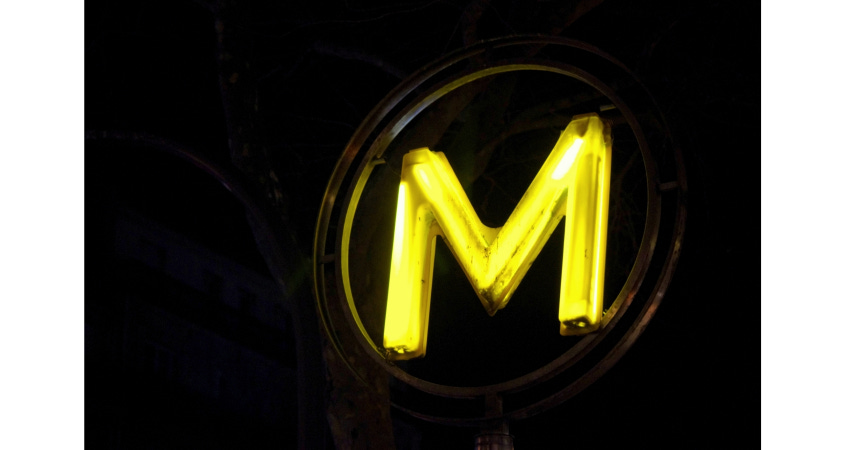
Still unsure of my path, I made my way through a couple of lonely streets and sought out the places where people gathered. Spotting the brightly-lit M for metro, I exhaled and bolted down towards it, in as much a hurry to get to the metro as I was to leave those sad and empty streets behind me. I was almost home free.
The relief was short-lived. I plunged into the Belleville metro entrance, jogging down the first set of stairs, and then imitated other night owls – the locals visibly didn’t feel the need to pay for a ticket at this late juncture – by hoisting myself up and over a turnstile. A young Asian woman held the barrier open for me. She flashed me a quick smile – a rare gesture in Paris – maybe recognizing the fear on my face. Then she took off running down a corridor.
The hall I needed was just ahead. As I panted through thick air, the sticky floor distracted me for a split second before I heard a distinctive high-pitched signal. Peering down the next staircase, my sneakers squeaked as I stopped short at the top of the steps. I was just in time to see the pale-yellow metro doors shutting with a clack-clack.
My stomach dropped and flattened in a place that felt close to my feet, and then seized into a knot. I’d missed the last metro, and was stuck in this place called Belleville, across the city from my new home. What was I going to do now?

I didn’t know it at the time, but Belleville is one of the most cosmopolitan Parisian neighborhoods, by way of its storied past. If the history of some areas of Paris is wrapped in pink paper with a shiny bow, Belleville’s is pasted together haphazardly using newsprint from an anarchist ‘zine and recycled supermarket Prix réduit! stickers. Longtime a city in its own right, Belleville has always integrated rabble-rousers, artists, and immigrants into its ranks.
In the 1700s, wealthy Parisians were building country homes in upper Belleville to take advantage of the expansive views over vineyards, windmills, fruit orchards, and the city of Paris in the distance. But lower Belleville was the purview of the “little people” who flocked to the cheap bars, taverns, and dance halls in town, which lay just beyond the Paris city limits.

The Farmer’s General wall, built in 1785 and encircling all of Paris, would prove to be one of the contributing factors of the French Revolution a few years later. From the time that tax wall was erected, leisure establishments drew even more Parisians beyond it, precisely because their location outside the city walls meant they weren’t subject to the taxes imposed on goods entering Paris.
The local low-quality wine or piquette coming down from the Belleville vineyards was also a cheap attraction. Very quickly, Belleville became le place to be among the working class: simply put, it provided inexpensive entertainment to the masses. Whereas the more civilized forms of leisure activities such as cabarets flourished outside the wall in Montmartre, Belleville became known for its guinguettes or dance halls, gargotes (greasy spoons), and goguettes (singing clubs).
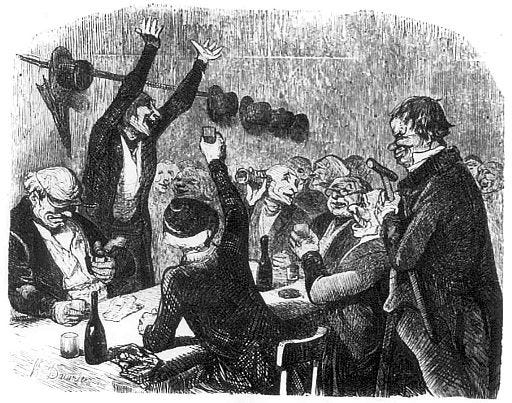
From drinking songs to patriotic hymns, the music at these goguettes was often performed by groups with names like “The Children of Bacchus.” The police stayed close at hand, because they rightly suspected that the creative freedom available in these establishments would foment revolution: political free-thinkers and anarchists gathered in the goguettes and other taverns in the area.
Belleville grew to become France’s 13th largest city in 1859. When Baron Haussmann created the 20 districts in 1860, incorporating Belleville into the city of Paris, his grand political program involved redistricting: spreading the former city over four different arrondissements was his attempt to divide and conquer the agitators of eastern Paris.
Belleville was even home to the last barricade during the 1871 uprising known as the Commune of Paris, whose famous Communards managed to topple the column in the Place Vendôme before it was all said and done.
And during that time, the Bellevillois continued to gather, eat, drink, and dance. The guinguettes were a brawler’s delight — as seen in Jacques Becker’s Casque d’Or — and the number of bars and cafés in Belleville grew at an exponential rate, reaching an astounding 448 by 1910.
By the time I arrived there, Belleville was known in Paris as a mini-Chinatown, due to the influx of Vietnamese, Laotian, and Chinese populations. But they didn’t come along until the 1980s, and they were preceded by a steady stream of immigrants from Greece, Armenia, Algeria and of Jews arriving from Tunisia and Poland. And in the 1960s, a massive influx of West Africans arrived in eastern Paris to settle in the newly-constructed foyers or immigrant housing centers.
It was early fall of 1995, and I'd been in Paris for a week. Getting settled into an apartment in the 7th district, not far from the Eiffel Tower, felt grown-up, and belied the fact that I had no job, no money, and no plan. But having that apartment was already something, and exploring the neighborhood on foot uncovered the rue Cler, the hospitable market street bustling with greengrocers and restaurants. It had that quaint neighborhood feel every visitor to Paris thinks is their own personal discovery.
Don’t miss the rest of this story! And please consider signing up for my newsletter below.
Wow. What a great story. Very well written. I am on a Caribbean island and that story made me feel like I was in Paris and running down slippery steps to catch the last metro. Well done Allison. I am looking forward to part two. Merci